
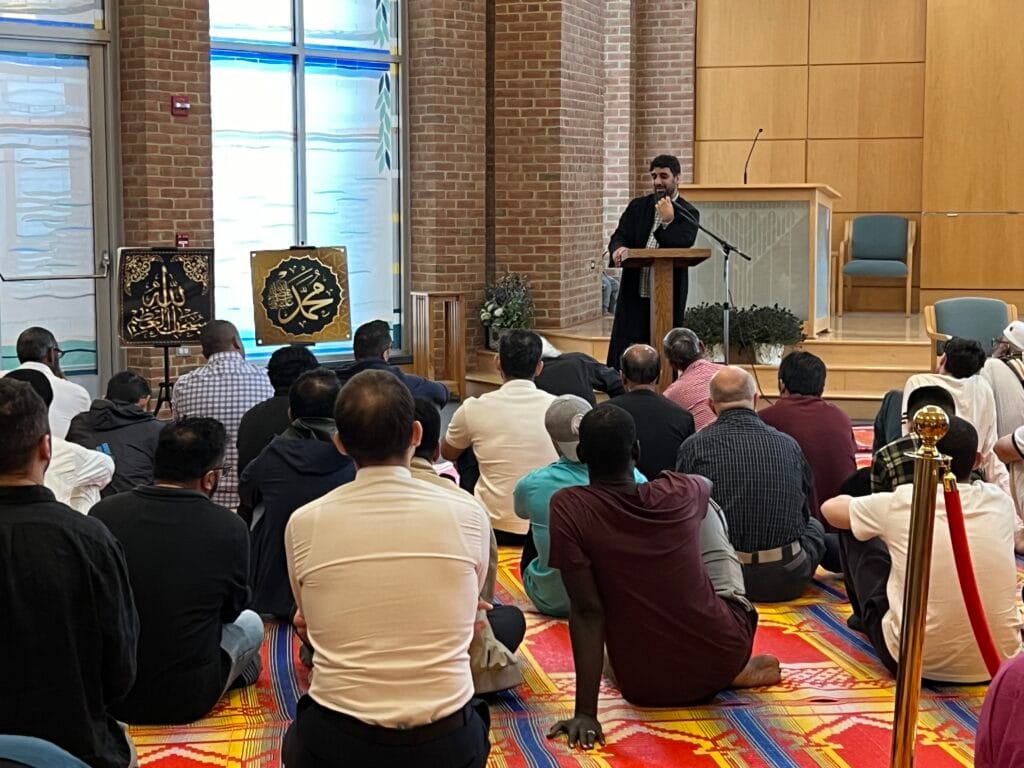
Notes from Jumu’ah Khutba by Ustadh Saad Omar on January 30
Purifying our intentions
Allah reminds us in the Qur’an:
يَـٰٓأَيُّهَا ٱلَّذِينَ ءَامَنُوا۟ ٱتَّقُوا۟ ٱللَّهَ حَقَّ تُقَاتِهِۦ وَلَا تَمُوتُنَّ إِلَّا وَأَنتُم مُّسْلِمُونَ
O you who believe – have taqwa of Allah as Allah deserves and die not except in a state of Islam. (Qur’an, Surah Al ‘Imran, ayah 102)
The Prophet Muhammad ﷺ said:
لا يقعد قوم يذكرون الله عز وجل إلا حفتهم الملائكة، وغشيتهم الرحمة ونزلت عليهم السكينة، وذكرهم الله فيمن عنده
When a group of people assemble for the remembrance of Allah, the angels surround them (with their wings), (Allah’s) mercy envelops them, Sakinah, or tranquillity descends upon them and Allah makes a mention of them before those who are near Him.
(narrated by Abu Hurairah; Hadith Muslim)
Let us make dua that our names be mentioned in that gathering.
But there is a condition to this: that the gathering must be for the sake of Allah. May our hearts be aligned with the intention that we are here only for Allah.
And this may seem strange to say this, because we are all here for jumu’ah. But we can’t assume that just because we’re at jumu’ah – an act of worship – that we are here for Allah. The hadith on intentions uses hijrah – migration for the sake of Allah – as an example. It was narrated that ‘Umar bin Al-Khattab, may Allah be pleased with him, said that the Messenger of Allah said:
إِنَّمَا الأَعْمَالُ بِالنِّيَّةِ وَإِنَّمَا لاِمْرِئٍ مَا نَوَى فَمَنْ كَانَتْ هِجْرَتُهُ إِلَى اللَّهِ وَرَسُولِهِ فَهِجْرَتُهُ إِلَى اللَّهِ وَرَسُولِهِ وَمَنْ كَانَتْ هِجْرَتُهُ لِدُنْيَا يُصِيبُهَا أَوِ امْرَأَةٍ يَتَزَوَّجُهَا فَهِجْرَتُهُ إِلَى مَا هَاجَرَ إِلَيْهِ
Actions are but by intentions, and each man will have but that which he intended. Whoever emigrated for the sake of Allah and His Messenger, his emigration was for the sake of Allah and His Messenger, and whoever emigrated for the sake of some worldly gain or to marry some woman, his emigration was for that for which he emigrated.
So if people do hijrah for Allah and His messenger, it will be accepted; but if you do hijrah for worldly gain, or for the sake of a woman, then that is what you will gain from it. So ask yourselves in your hearts:- are we here for Allah, and only Allah? And if not, then let us realign our intentions.
Preparing for Ramadan
We are in the blessed days of Sha’ban.
The companions used to say that when they observed the Prophet Muhammad ﷺ in Sha’ban, they would think it was Ramadan – such was the extent of his fasting and prayer.
What lesson can we take from this? If we want our Ramadan to be beautiful, we have to prepare beforehand. Just as we have been learning how preparation is essential to prayer: we know that prayer is not a helicopter, you cannot launch into the act instantaneously from a helipad; it’s a plane, and we need a runway to prepare for flight. Similarly, we need a runway to prepare for Ramadan. Because if we don’t prepare ahead of time, we end up using half of Ramadan as the runway – and Ramadan is far too precious to waste even a moment.
So – we must use Sha’ban as the runway to prepare for Ramadan.
Moreover, we don’t know if we will reach Ramadan – there are people who pass away before Ramadan starts. Let us make du’a that we will reach the next Ramadan.
Let us look at the examples of the companions, who for six months after Ramadan would make du’a that their previous Ramadan had been accepted; and for the next six months they would prepare for the upcoming Ramadan.
Practical steps to prepare for Ramadan during Sha’ban
For the remaining half of Shaban, let us commit to some practical actions to help us prepare for Ramadan.
First, let us make the intention of fasting every Monday and every Thursday. This was the sunnah of the Prophet ﷺ. We can make this a collective, community goal and intention, and remind each other.
The Prophet ﷺ would fast often; during his marriage to Aisha (رضي الله عنه), he would ask, “is there something for dinner.” Oftentimes, there was no food in their home, and if they didn’t have food, he would say that he was fasting. Similarly, during his 25-year marriage to Khadija (رضي الله عنه), he would never ask “what is for dinner?” but instead “is there something for dinner?” He would often fast for half the year.
But why did the Prophet ﷺ particularly fast on Mondays and Thursdays? Abu Qatada al-Ansari (Allah be pleased with him) reported that the Messenger of Allah (ﷺ) was asked about his fasting.
قَالَ وَسُئِلَ عَنْ صَوْمِ يَوْمِ الاِثْنَيْنِ قَالَ ” ذَاكَ يَوْمٌ وُلِدْتُ فِيهِ وَيَوْمٌ بُعِثْتُ أَوْ أُنْزِلَ عَلَىَّ فِيهِ
He was then asked about fasting on Monday, whereupon he said: It was the day on which I was born. on which I was commissioned with prophethood or revelation was sent to me.
It’s interesting that he references the day of his birth – and while there are differences of opinion about celebrating mawlid, there are no differences of opinion on this hadith and the sunnah of fasting on Mondays.
As for Thursdays, the Prophet ﷺ said:
تُعْرَضُ الأَعْمَالُ يَوْمَ الاِثْنَيْنِ وَالْخَمِيسِ فَأُحِبُّ أَنْ يُعْرَضَ عَمَلِي وَأَنَا صَائِمٌ
Deeds are presented on Monday and Thursday, and I love that my deeds be presented while I am fasting.
(narrated by Abu Hurairah; Hadith at-Tirmidhi)
Second, let us try to pray 2 rakah tahajjud at least every other day.
Third, let us strive to read a minimum of three pages of Qur’an every day. Some scholars say this is the minimum we need to read so the Qur’an doesn’t testify against us.
Maintaining our efforts after Ramadan
We must remember that we don’t worship Ramadan, we worship the Lord of Ramadan. We cannot make Ramadan the idol, where we lose our attachment once the month is done. Our relationship should not be transactional.
Anse Tamara Gray teaches us that one of the greatest nights of worship is the night of Eid after Ramadan – because it is our proof that our connection was not just to the month, but to the Lord of the month.
We need to strengthen ourselves before Ramadan, so that our efforts during Ramadan are protected; and remember that what we consider “extra” efforts in Ramadan were an everyday level of effort for the companions of the Prophet ﷺ.
The three levels of fasting and what we should strive for
We have been taught in our deen that there are three levels of fasting – in parallel to the stages of Islam, Iman and Ihsan.
First, the fasting of everyday believers (Muslims). This is the baseline of fasting, which consists of refraining from food, drink, and intimacy.
Second, is the fasting of the righteous (or Mu’mins). This is the fast of people who Allah is pleased with. This fast consists of refraining not just from food, drink, and intimacy, but also from all sins. This requires an extra level of effort, preparation, and consciousness. It is hard to break habits – and if we want to break sinful habits, we need to start training ourselves before Ramadan. Ask yourselves: what is the last thing you think about when you sleep, and the first thing you think about when you wake up? Is it Allah or is it our phone? This is the mentality we need to shift if we want to attain this level of fasting. Some scholars used to even consider their fast broken if they even thought about iftar (not legally, but in their hearts).
The Prophet Muhammad ﷺ said,
رُبَّ صَائِمٍ لَيْسَ لَهُ مِنْ صِيَامِهِ إِلاَّ الْجُوعُ. وَرُبَّ قَائِمٍ لَيْسَ لَهُ مِنْ قِيَامِهِ إِلاَّ السَّهَرُ
There are people who fast and get nothing from their fast except hunger, and there are those who pray and get nothing from their prayer but a sleepless night.
(narrated by Abu Hurairah; Hadith Ibn Majah)
Third, is the fasting of the Prophets and the sabiqoon (or Muhsins). These are the people mentioned in Surah Waqiah:
وَٱلسَّـٰبِقُونَ ٱلسَّـٰبِقُونَ
…and the foremost in faith will be the foremost in Paradise.
(Qur’an, Surah Al-Waqi’ah, ayah 10)
This is also the state of the angels, even though they don’t fast since they don’t eat or drink. This state consists of fasting from anything but Allah; where everything but Allah disappears and only Allah remains. After a Ramadan in this state, we may go back to eating food, but we don’t have the same connection to food – we eat to worship, we pray for the people who made the food, but we don’t desire food or eat for the sake of eating as we did before.
Strengthening our community in Ramadan
The blessing of a smaller community like this, is that we can know each other and care for each other. We are small enough that we are alike to the size of early community of Muslims in Makkah before hijrah.
In Ramadan, let us become closer to each other. In particular, may Allah increase love of children for this masjid; may they always feel at home in this masjid.
Ramadan is supposed to transform us – but don’t wait for the change to start at the beginning of Ramadan, let Ramadan complete the change.
Visit our Prayers page for more information about our Jumu’ah Prayers