
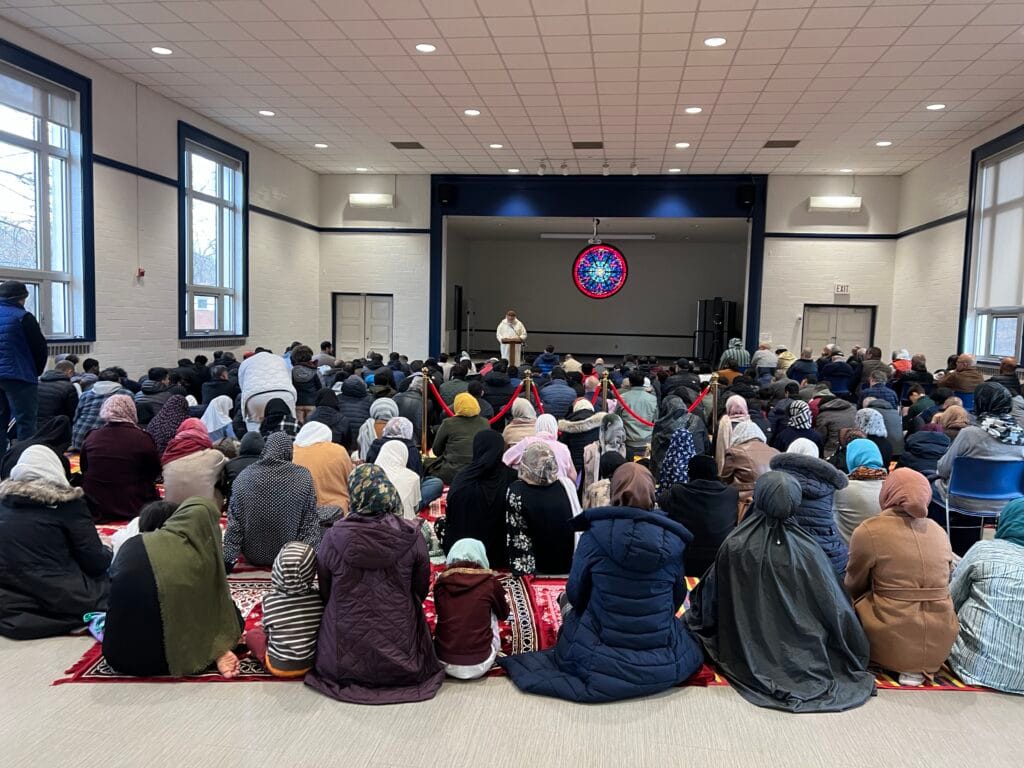
Attainment of the Great Bliss (al-yusrā) by Daoud Casewit – Khutbah delivered on November 28, 2025
The following is the transcript of the Khutbah delivered by Br. Daoud Casewit on Friday, November 28 at MIIC.
Khuṭbah: Attainment of the Great Bliss (al-yusrā) through active affirmation of the comprehensive and ultimate Good (al-ḥusnā)
الحمد لله ثمّ الحمد لله، الحمد لله حمدًا يوافي نِعَمَهُ ويُكافِئُ مزيدَه، وأشهد أن لا إله إلاّ اللهُ وحده لا شريك له، وأشهد أنَّ سيِّدَنا ونبيَّنا محمّدًا عبدُه ورسوله، واللذي بعثتَهُ بالصِدْقِ، وداعياً الى الحسنى وميسِّراً لليُسرى، اللّهم صلِّ وسلِّم وبارك على سيِّدِنا محمّد، وعلى آل سيدنا محمّد، صلاتًا وسلامًا دائِمَيْن مُتلازِمَيْن إلى يومِ الدينَ.
أمّا بعدُ فيا إخوة الإيمان، السلام عليكم ورحمةُ الله وبركاتُه.
The theme I wish to treat today is based on the following verses from Sūrat al-Layl (Chapter of the Night):
إِنَّ سَعْيَكُمْ لَشَتَّى (4) فَأَمَّا مَنْ أَعْطَى وَاتَّقَى (5) وَصَدَّقَ بِالْحُسْنَى (6) فَسَنُيَسِّرُهُ لِلْيُسْرَى (7) وَأَمَّا مَنْ بَخِلَ وَاسْتَغْنَى (8) وَكَذَّبَ بِالْحُسْنَى (9) فَسَنُيَسِّرُهُ لِلْعُسْرَى (10)
“Verily your strivings are diversified <> As for he who gives in charity and is righteous <> and actively affirms the comprehensive and ultimate good <> We shall facilitate his path to the Great Bliss <> As for he who is stingy and proudly self-centered <> and denies the ultimate good <> We shall facilitate his path to constrained hardship.”
In contemplating the implications of affirming the truth of the ultimate good (al-taṣdīq bi-l-ḥusnā), let me highlight some of the fundamental principles of that affirmation. This khuṭbah is divided into three main sections which constitute the foundations of attaining the Great Bliss (al-yusrā): firstly, thinking well of God (ḥusn al-ẓann bi-‘Llāh); secondly, thinking well of fellow human beings (ḥusn al-ẓann bi-l-nās); and finally, a person’s thinking well of his/her own soul (ḥusn al-ẓann al-mar’u bi-nafsihi).
The majority of Quran commentators are of the opinion that Paradise is the most evident meaning of al-ḥusnā in the above cited verses, as is the case in God’s words “to those who respond to their Lord belongs al-ḥusnā”. It is also well-established that al-ḥusnā, like al-ḥasanah, is an expression for the reward which God gives as recompense to those who are charitable in His path, and this may come in this world or in the Afterlife or in both together.
Though there are various traditional reports concerning the identity of the generous companion described in Sūrat al-Layl, some sources say that it was revealed in reference to a man of the Muslim natives of Madinah (al-Anṣār) whose name was Ibn al-Daḥdāḥ, who became a by-word for stupendous charitable giving. The following is a summary of one of these reports as related by al-Wāḥidī in his book on the causal circumstances of revelation of select verses of the Quran:
There was a man who had a date palm tree whose trunk leaned over the residential compound of a poor man. When he climbed the date palm in order to harvest its fruit, some of it would fall to the ground, and the poor man’s children would gather it, whereupon the man would descend and take the dates from their mouths. The poor man went to complain of this to the Messenger ﷺ, and when he met the owner of the date palm, the Prophet ﷺ told him, “Give me your leaning date palm tree, and you will have a date palm in Paradise in lieu of it.” The man responded, “I have many date palms, and there is not one date palm tree among them whose fruit I like more than this one.” Hence, he declined the offer and departed. Then Ibn al-Daḥdāḥ came and said, “O Messenger of God, would you give me that which you would have given to the man, a date palm tree in Paradise, if I were to acquire it?” And the Prophet ﷺ said, “Yes.” So, Ibn al-Daḥdāḥ went to the owner of the date palm seeking to purchase it. And the man said to him, “Are you aware that Muhammad ﷺ offered me a date palm in Paradise for it?” Then he asked him for forty date palm trees in exchange for it. Ibn al-Daḥdāḥ was taken aback at this steep price, but ultimately agreed to the transaction and subsequently bequeathed the date palm to the Prophet ﷺ who in turn went to the house of the poor man and said, “Verily the date palm now belongs to you and your family.”
This anecdote reveals the power of sincere hope for exceptional reward in the Afterlife to propel a believer into making a weighty sacrifice for its sake. And it demonstrates how, in his Other-worldly yearning, Ibn al-Daḥdāḥ is characterized by thinking well of God, whence his pro-active belief in the promised reward in Paradise; and by thinking well of people, since he did not blame the man for clinging to his legitimate ownership of the date palm, nor did he judge the poor man to be undeserving of receiving it; and finally by thinking well of his own soul, since his question to the Prophet ﷺ is evidence of his hope in his own worthiness to obtain the eternal date palm. And with such confidence, he was prepared to undertake the required sacrifice.
Thinking well of God (ḥusn al-ẓann bi-Llāh) comprises the meaning of beauty of thought (zayn al-ẓann), and fullness of thought (kamāl al-ẓann) as well as soundness of thought, as is required by giving God his just measure (taqdīr). In a hadith narrated by Abū Dāwūd, the Prophet ﷺ said, “Thinking well of others (ḥusn al-ẓann) is part of worshipping well (ḥusn al-ʿibādah).” Here the secret of praising God (al-ḥamdalah) manifests itself, for it is by this means that we acknowledge God as the source of all good. And through our gratitude for God’s innumerable blessings and our appreciation for the manifestations of His Beauty that we realize a key portion of al-taṣdīq bi-l-ḥusnā.
It is certain that God’s reckoning is founded upon a cosmic economy by which we attain unfailing profits as God promised in the verse: “Verily God does not waste the wages of those who do good.” Moreover, this cosmic economy is carried out in the context of God’s immense generosity towards His sincere servants, and His indulgent forgiveness for their lapses and faults. Indeed, the magnanimity of our Lord goes beyond all numerical calculations in an absolute fashion according to the verse: “Verily God gives provision to whom He wills without reckoning.” The mighty extent of His generosity derives from the breadth of His all-encompassing Mercy. In a widely-cited hadith narrated by al-Ḥākim, we learn that the Merciful (al-Raḥmān) seeks out opportunities to exercise His Mercy: “If the servants did not commit sins, God would create a people who sinned and then sought forgiveness, and then God would forgive them, and He is the Forgiving, the Beneficent.”
To summarize this section, it is evident that our thinking well of God is the basis for a process of good mutual responsiveness (al-tajāwub) and good mutual approach (al-taqārub). In a hadīth qudsī narrated by Muslim, God says: “I am in accordance with the thought my servant has of me, and I am with him when he remembers Me. And God is more overjoyed at the repentance of his servant than one of you who has found a cherished lost thing in the desert wastes. Whoever comes towards Me by a hand span, I come towards him by an arm’s length, and whoever comes towards Me by an arm’s length, I come towards him by a fathom, and if he comes towards Me walking, I come towards him rushing in haste.” Glorified art Thou, Yā Allah!
Moving on to the second theme of my talk, Sūrat al-Layl illustrates that al-taṣdīq bi-l-ḥusnā obliges us to be attentively responsive towards God and His servants. Supporting this principle is a hadith narrated by Muslim in which the Prophet ﷺ says: “None shall enter Paradise who has in his heart a grain’s weight of pride (kibr).” And when it was said that a man likes to have a handsome robe and fine footwear, he replied, “Verily God is beautiful and loves beauty. Pride is arrogant denial of the truth (baṭr al-ḥaqq) and haughty contempt for people (ghamṭ al-nās).” Thus, we see that being granted entry into Paradise is conditional upon the absence of prideful self-sufficiency with regard to God and with regard to His servants.
Consequently, thinking well of other people excludes distaining them on account of apparent poverty, just as it excludes envying them on account of apparent prosperity. True dignity (karāmah) is not measured by wealth or offspring, as is borne out by the verse: “Verily the most honored among you before God are those of you who are most upright/vigilant (atqākum)”.
We uncover the ultimate possible effect of thinking well of others in a hadith narrated by Muslim in which the Prophet ﷺ said as he was attending a funeral, “‘Any Muslim whose goodness is attested by four others, God will cause to enter Paradise.’ And we asked him, ‘What about three?’ And he said, ‘And three.’ Then we asked him, ‘What about two?’ And he said, ‘And two.’ Subsequently, we did not ask him about a single witness.” From this it is evident that our belief in Paradise is strengthened by our belief in the existence of its blessed future inhabitants amongst us.
And there is a reverse benefit in thinking well of others, since our love for the pious may well be a cause for our being included in their host. In a hadith narrated by both al-Bukhārī and Muslim we find: “One day a man of the Bedouin came to the Prophet ﷺ and said, ‘O messenger of God, when will the Final Hour occur?’ To which he replied, ‘Woe unto you! And what have you prepared for that day?’ And he said, ‘I have not prepared much for it beyond the fact that I love God and His Messenger.’ And the Prophet ﷺ said, ‘Verily you will be among those you love.’ And we asked him, ‘And are the rest of us the same?’ To which he said, ‘Yes.’ And on that day, we rejoiced with extreme joy.”
Naturally, there is no escaping the need to take precautions against those who plot evil and those who deny the truth of al-ḥusnā, seeking to safeguard our worldly and otherworldly interests; however, this should be done with an inclination towards thinking well of others, and from there, saying good things and doing good. And I bear witness to the existence of the great number of excellent persons in our religious community, and I have no doubt that in addition to these people of good will and good works (al-muḥsinīn) there exists a vast host of similar men whom God knows and loves and who love Him. With feelings like these, we provision ourselves with increased confident hope in admission into the Great Bliss (al-yusrā).
اقُولُ قَولِي هذا و اَستَغْفِرُ اللَّهَ لي و لكم
————————————————————-
(Here the pause and sitting between first & second half of kutbah.)
الحمدُ للِّهِ ربِّ العالمين /
و الصَّلاةُ و السَّلامُ على رسولِهِ الأَمين
/أَمَّا بعدُ فَيا مَعْشَرَ المُسْلِمِين
Now I shall delve into the third and final section of this khuṭbah. In thinking well of oneself, I mean our good hope in God’s mercy and our justifiable aspiration for salvation. This primordial (fiṭrī) aspiration is enclosed within the secret of the truth: Verily we belong to God and to Him we are returning. This is because the certain knowledge of our belonging to Him, from the point of view of origin, leads us to confidence in our primal worthiness of a good return unto Him.
God says: “Is it not in remembering God that hearts find tranquility?”, and in another verse: “In the Messenger of God have you indeed a good example for those who focus their aspirations on God and the Last Day and who remember God much.” There are those who believe that our current age is full of unprecedented demands and pressures which make it nearly impossible to achieve congruity between religion and the world. Yet, how many facilitating dispensations do we ignore, and how many opportunities for doing good do we disregard?
It bears stressing, that our daily life affords us plentiful means for fulfilling our religion, to the extent that all of our constructive and well-executed works are pleasing to God. This is understood from a hadith narrated by al-Bayhaqī: “Verily God loves it when one of you undertakes a task that he do it to perfection (yutqinahu).”
Following the example of he ﷺ who was sent to fully realize the most honorable traits of character (li-yutammima makārima al-akhlāq), we are obliged to make every effort to establish a congruence (tawāfuq) between the excellence of our worship and the excellence of our interaction with our surroundings. This is in accordance with a hadith narrated by Abū Dāwūd: “The most complete of believers in faith is the best of them in moral character.” In order to polish the character which attests to our thinking well of God and of people, we are assisted by a hadith narrated by al-Tirmidhī: “Whoever focuses, in matters of the world, on he who is inferior, and in matters of religion on he who is superior, God shall make him patient and thankful. And whoever focuses, in matters of the world, on he who is superior, and, in matters of religion, on he who is inferior God shall make him neither patient nor thankful.”
Sūrat al-Layl makes it clear that charitable giving (al-ṣadaqah) is among the most desirable of good deeds, since it is a sign of sincere and active affirmation of the comprehensive and ultimate good (al-taṣdīq bi-l-ḥusnā). God says in the Quran: “And strive in that which God has given you for the realm of the Hereafter <> and forget not your portion of this lower world <> and be magnanimous (aḥsin) as God has been magnanimous to you.” Given that these verses are addressed to Qārūn, a proud, miserly man of great power and wealth, al-Ghazālī interprets them as follows: “Forget not in this lower world your portion of it for the Afterlife, for it is the planting field (mazraʿah) for the Next World and in it you earn celestial merit.” Giving for the sake of God is among the most effective means of cultivating that planting field, especially since the gifts of charity acceptable to God embrace every well-intentioned act, even if it be as modest as a smile or a kind word. Let us recall the verse which states: “And whoever is stingy, is stingy to his own soul <> and God is the Rich and you are the poor.”
Last but not least, I wish to complete my khuṭbah with glad tidings of one of the sweetest and most blessed of works in terms of its fruits which is accessible to all believers, and this is the prayer of benediction upon our Prophet ﷺ. According to hadith, he who fails to utter blessings upon him when his name is mentioned is indeed niggardly, stingy to his own soul since with every blessing we ask for him, God blesses us tenfold. It is also among the most mandatory acts of obedience, since God says: “Verily God and His angels bless the Prophet <> O you who believe bless him and greet him with greetings of peace.” In this heavenly command we find that through our petition for blessings upon him we integrate ourselves into the timeless act of God –may He be glorified!– and the act of the angels.
O God! Bless and grant peace and pour grace upon our heavenly messenger Muhammad ﷺ and upon his family and companions and upon those who follow them in good and beautiful works until the Day of Judgment. Our Lord, cause us to think well of Thee so that we might be guided to your good pleasure (riḍwānik). Our Lord, and steer our hearts away from harboring rancor against those who believe, and permit us to derive benefit from our love for the best of them. Our Lord, establish us in rectitude (istiqāmah) so that we might have justification for thinking well of our own souls and facilitate our path to good and beautiful works. Our Lord, fortify our active affirmation of al-ḥusnā in this lower world and cause us to attain admittance into al-yusrā in the Afterlife. Our Lord, grant us good (al-ḥasanah) in this lower world and good in the Hereafter, and guide us all to the Great Bliss (al-yusrā).
Āmīn, thumma āmīn. Wa al-ḥamdu li-Llāhi rabb al-ʿālamīn.
Read more about Br. Daoud Casewit here
Visit our Prayers page for more information on our daily and Friday prayers